How to Build a Trading Journal That Actually Improves Your Funded Account Performance
Most traders know they should keep a journal.
Very few actually use one properly.
For many traders, a journal is just a place to write down entries, exits, screenshots, or emotional thoughts after a bad trade. They open it when something goes wrong, type a few lines, and then forget about it until the next loss. That kind of journal may feel productive, but it rarely improves performance.
A real trading journal does something different.
It shows patterns.
It exposes mistakes.
It helps reveal which strategies perform best over time.
It reveals which market conditions hurt you.
It helps you understand whether your funded account is being managed with discipline or emotion.
In funded trading, this matters even more. A personal account can survive messy habits for a while. A funded account often cannot. When you are trading inside a prop firm environment, every decision matters because each account model has its own drawdown framework, payout rules, and trading conditions.
Forex Funds Flow, also known as FFF, gives traders a more structured way to review performance through its Traders Dashboard. One of the most useful features inside the dashboard is the Journal section, where traders can review trades, add notes, apply strategy tags, filter trades by setup type, and organize their performance history. The dashboard also includes account comparison tools, performance metrics, radar visuals, and equity curves, helping traders understand their strengths and weaknesses more clearly.
This is important because traders do not improve by simply taking more trades.
They improve by reviewing better.
In this article, we will break down how to build a trading journal that actually improves funded account performance, how to use FFF’s journal features properly, and how traders can turn trade history into a real performance edge.
Why Funded Traders Need a Journal More Than Regular Traders
Every trader needs feedback, but funded traders need it faster.
In a funded account, there is less room for repeated mistakes. You cannot keep revenge trading every week and expect the account to survive. You cannot ignore drawdown rules and hope the next trade fixes everything. You cannot overleverage, force setups, and treat every loss like a personal attack.
A funded account rewards discipline.
A journal helps you measure discipline.
Without a journal, many traders rely on memory. That is dangerous because memory is emotional. After a win, a trader remembers confidence. After a loss, they remember frustration. After a strong week, they may believe the strategy is better than it really is. After a bad day, they may feel the entire system is broken.
A journal helps reduce guesswork.
It lets you see the truth.
Are your breakout trades actually profitable?
Do you lose more on counter-trend setups?
Is scalping helping your account or increasing overtrading?
Do you perform better on XAUUSD or indices?
Are most losses coming from bad entries or poor exits?
Are your best trades coming from trend-following setups?
Do you hold winners long enough?
Do you cut losing trades early enough?
These questions cannot be answered honestly without data.
That is why Forex Funds Flow’s dashboard journal is valuable. It gives traders a place to review real trade behavior, not just trade results. The goal is not only to know whether a trade won or lost. The goal is to understand why the trade happened, how it was managed, and whether it should be repeated.

What Makes a Trading Journal Useful?
A useful trading journal has three layers.
The first layer is trade data. This includes the symbol, direction, lot size, entry, exit, profit or loss, trade time, and account impact.
The second layer is strategy context. This explains what type of setup the trade was. Was it a breakout? Trend-following trade? Mean reversion setup? Scalping entry? Swing trade? News trade? Support and resistance reaction? Pattern trade? Momentum play? Counter-trend idea?
The third layer is personal review. This is where the trader writes what happened, what they felt, what they followed, what they ignored, and what lesson should be taken from the trade.
Most traders only record the first layer.
That is not enough.
Data tells you what happened. Context tells you why it happened. Notes tell you what to improve.
FFF’s Journal feature supports this structure well because traders can tag trades by strategy type and add notes directly under the trade. This turns the journal from a basic record into a performance review system.
A strong journal should help you answer one simple question:
What should I do more of, and what should I stop doing?
If your journal cannot answer that, it is not detailed enough.
FFF Journal Feature: Built for Trade Review
The Forex Funds Flow Traders Dashboard includes a dedicated Journal tab inside the account area. This gives traders a clear space to review trades, search through history, filter by strategy type, and add trade notes.
From the dashboard view, traders can search by symbol or notes, which makes it easier to find specific trades later. This is useful when reviewing repeated mistakes or studying a specific instrument. For example, if a trader wants to review all XAUUSD trades, the search feature can help them narrow the focus quickly.
The dashboard also includes strategy filters such as Breakout, Trend Following, Mean Reversion, Scalping, and Swing Trade. These filters make the journal more powerful because traders are not just reviewing all trades together. They can separate performance by trading style.
This matters because many traders think they have one strategy, but in reality they are trading many different behaviors.
A trader may say, “My strategy is not working.”
But the journal may reveal something more specific:
Breakout trades may be more profitable.
Trend-following trades may be stronger.
Mean reversion trades are weak.
Scalping trades create too many losses.
Swing trades perform better with smaller lot size.
Counter-trend trades cause the biggest drawdown.
That level of clarity can significantly improve decision-making.
FFF’s journal also shows individual trade entries with profit or loss, symbol, direction, trade status, lot size, price, and timing. When a trade is expanded, traders can apply strategy tags and add trade notes. The notes section gives traders room to write observations, mistakes, lessons, or market context.
There is also a note sync message in the dashboard, showing that notes can sync across devices. This is useful for traders who review on one device and trade or monitor from another. Good journaling should not be limited to one screen.
A journal works best when it is easy to use.
The easier it is to record the lesson, the more likely traders are to build the habit.
Strategy Tags: Turning Trade History Into Real Insight
One of the strongest features inside the FFF Journal is the ability to use strategy tags.
Tags may look simple, but they are extremely powerful.
A tag turns a trade into a category. Once trades are categorized, performance can be reviewed by setup type instead of emotion. This helps traders understand which strategies truly support their funded account and which ones quietly damage it.
The FFF dashboard includes tags such as:
Breakout
Trend Following
Mean Reversion
Scalping
Swing Trade
News Trading
Support/Resistance
Pattern Trading
Momentum
Counter-Trend
These tags help traders organize their history in a way that matches real trading behavior.
For example, a trader may notice that their Breakout and Trend Following trades are responsible for most profits, while Mean Reversion and Counter-Trend trades create most losses. Another trader may discover that Scalping works well during London session but poorly during slow market hours. A swing trader may discover that Support/Resistance trades perform better than Momentum entries.
This is how journaling becomes useful.
It stops the trader from making broad emotional conclusions.
Instead of saying:
“I am bad at trading.”
The trader can say:
“My counter-trend trades are hurting my account.”
That is a much better problem to solve.
Good traders do not fix everything at once. They identify one weak behavior and improve it. Strategy tags make that possible.
Trade Notes: Where the Real Lesson Is Written
Numbers tell part of the story.
Notes provide the context behind those numbers.
A trade can be profitable but still poorly executed. A trade can lose but still be a good decision. Without notes, traders often judge trades only by outcome. That is one of the biggest mistakes in trading review.
A good journal note should answer four questions:
Why did I take this trade?
Did I follow my plan?
What happened during the trade?
What lesson should I carry forward?
For example, a weak note says:
“Lost trade. Bad entry.”
A better note says:
“Entered early before confirmation. Setup was marked as breakout, but price had not closed above resistance. Loss was acceptable, but execution was impatient. Next time, wait for candle close and volume confirmation.”
That type of note improves future behavior.
The FFF Journal gives traders a dedicated space to add trade notes directly under expanded trades. This is useful because the note stays connected to the actual trade. The trader does not need to search through a separate notebook, spreadsheet, or app. The trade and the lesson sit together.
This helps build a clean review process.
A funded trader should not only journal losses. Winning trades should be reviewed too. Sometimes a win hides bad behavior. Maybe the trader used too much risk, entered late, ignored the stop plan, or got lucky during news volatility.
The goal is not to feel good after wins and bad after losses.
The goal is to judge decision quality.
That is what separates emotional traders from professional traders.
Search and Filters: Reviewing With Purpose
A journal becomes powerful when traders can find patterns quickly.
This is where search and filters matter.
The FFF Journal includes a search bar that allows traders to search by symbol or notes. This helps traders focus on specific markets, repeated setups, or written observations.
For example, a trader can search for a symbol like XAUUSD to review all gold trades. This can reveal whether gold is actually helping the account or simply attracting emotional decisions. Many traders love trading gold because it moves fast, but the journal may show that the volatility is causing poor entries and larger floating losses.
A trader can also search notes for words like “early,” “revenge,” “news,” “late entry,” or “no confirmation.” Over time, repeated words reveal repeated habits.
Filters make review even cleaner.
Instead of reviewing every trade together, traders can filter by strategy tags. This allows a trader to compare performance by setup type and ask better questions:
Do breakout trades work better than mean reversion?
Are scalping trades causing overtrading?
Are swing trades producing better risk-to-reward?
Are news trades creating unnecessary account pressure?
Are counter-trend trades worth keeping?
A serious trader does not need more opinions.
They need cleaner evidence.
FFF’s Journal helps traders organize that evidence inside the dashboard.
Account Comparison: Journal Performance Across Accounts
Another important FFF dashboard feature is account comparison.
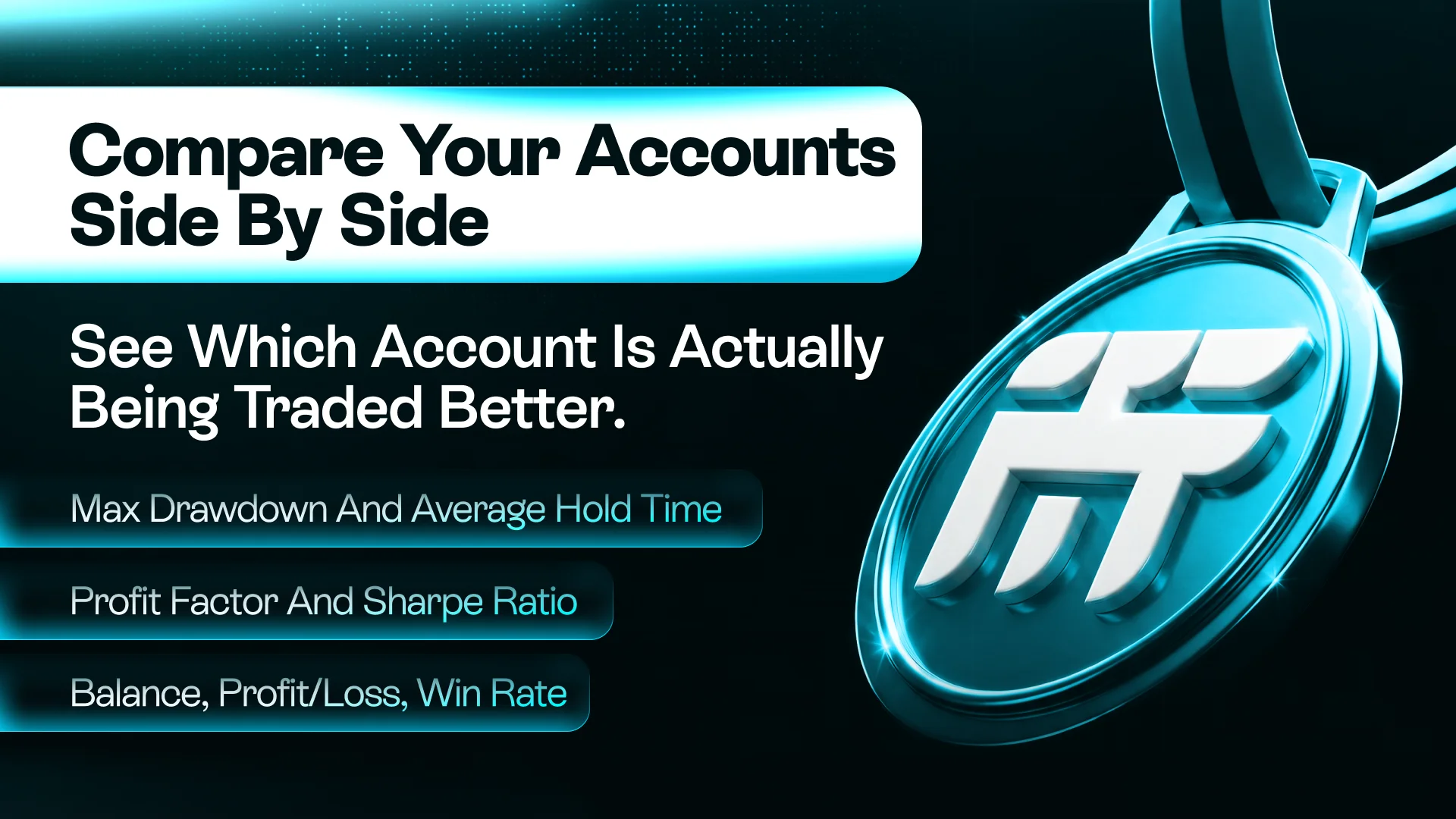
The Account Comparison section allows traders to compare performance across multiple accounts side by side. This is valuable because many traders manage more than one account model or account size, and performance can vary depending on rules, drawdown structure, and trading behavior.
The comparison dashboard includes key performance metrics such as balance, profit/loss, win rate, profit factor, Sharpe ratio, total trades, best trade, worst trade, max drawdown, and average hold time.
These metrics help traders move beyond basic profit and loss.
A trader may have one account with a higher profit but worse drawdown. Another account may have lower profit but cleaner consistency. One account may show better win rate, while another shows better risk-to-reward. Without comparison, it is easy to misunderstand which account is actually being traded better.
For funded traders, this matters because performance quality is more important than short-term profit.
A trader who makes profit through uncontrolled drawdown is not trading better. They are taking more risk.
A trader who earns smaller profit with cleaner risk may be building a more sustainable process.
The Account Comparison feature can help traders see which account behavior is healthier. When combined with journal tags and notes, it becomes even stronger.
For example, if one account has worse drawdown, the trader can check whether that account had more scalping trades, more counter-trend setups, or more emotional notes. This connects performance metrics with trading behavior.
That is how traders improve.
They connect the numbers to the decisions that created them.
Performance Metrics: What Funded Traders Should Watch
A good trading journal should not only record trades. It should measure performance quality.
FFF’s dashboard comparison includes metrics that funded traders should review regularly.
Win rate shows how often trades are profitable. But win rate alone is not enough. A trader can have a high win rate and still lose money if losses are much larger than wins.
Profit factor gives a deeper view because it compares gross profit to gross loss. A profit factor above 1 means the system is producing more profit than loss. The higher the quality of execution, the more useful this metric becomes.
Sharpe ratio helps traders understand return compared to volatility. In simple terms, it can show whether returns are smooth or unstable. For funded traders, smoother performance can be valuable because large swings can threaten drawdown limits.
Total trades reveals activity level. If performance drops when trade count rises, the trader may be overtrading.
Best trade and worst trade reveal whether the trader is depending too much on one winner or allowing one loser to create too much damage.
Max drawdown shows how much pressure the account experienced. This is one of the most important metrics in funded trading because account survival depends on drawdown control.
Average hold time helps traders understand whether their real behavior matches their intended style. A trader who claims to scalp but holds losing trades for hours may have a discipline issue. A swing trader who closes every trade too quickly may have a patience issue.
These metrics turn the journal into a performance dashboard.
The trader can stop guessing and start improving based on evidence.
Performance Radar and Equity Curves: Seeing the Bigger Picture
The FFF dashboard also includes visual tools such as a performance radar and equity curves.
The performance radar gives a visual overview of key metrics like win rate, profit factor, total trades, Sharpe, consistency, and risk/reward. This helps traders quickly see where one account is stronger or weaker than another.
Visual tools matter because traders often miss patterns in raw numbers.
A radar chart can show that one account has better consistency but weaker risk/reward. Another may have strong returns but poor stability. This helps traders understand performance shape, not just performance result.
The equity curve is even more important.
An equity curve shows how the account grows or declines over time. It reveals whether performance is smooth, choppy, emotional, or unstable.
A healthy equity curve usually reflects controlled risk and consistent execution.
A dangerous equity curve often shows sharp spikes, deep drops, sudden recoveries, and emotional trading behavior.
For funded traders, the equity curve is one of the clearest mirrors of discipline.
If the curve rises slowly and steadily, the trader may be following a stable process. If the curve jumps up and crashes down, the trader may be overleveraging or taking inconsistent risk.
A journal explains why the curve moved.
The equity curve shows what happened.
The notes and tags show why it happened.
Together, they create a complete review system.
How to Build Your Journal Routine With FFF
A trading journal only works if it becomes a habit.
The best routine is simple enough to repeat.
Before the trading session, define your plan. Write down the markets you will focus on, the setups you are allowed to take, your maximum daily risk, and your stop conditions.
During the session, tag trades correctly. Do not wait until the end of the week and try to remember. If the trade is a breakout, tag it as Breakout. If it is a counter-trend trade, tag it honestly. The journal is only useful if the information entered is accurate.
After each trade, add a short note. It does not need to be long. It needs to be honest.
At the end of the day, review your trades. Look for repeated mistakes, emotional entries, oversized losses, or rule breaks.
At the end of the week, review by tag. Check which strategies performed best and which ones damaged the account.
At the end of the month, review metrics and equity curves. Compare accounts if you trade multiple FFF accounts. Look for improvement in drawdown, win rate, profit factor, and average hold time.
A strong weekly review might include these questions:
Which strategy tag produced the best results?
Which tag produced the worst results?
Did I follow my risk rules?
Did I trade more after losses?
Did I respect drawdown?
Did my equity curve show stability or emotional swings?
Which account was traded most professionally?
What one behavior should I improve next week?
The goal is not to write more.
The goal is to learn faster.

Common Journaling Mistakes Funded Traders Should Avoid
The first mistake is journaling only losses.
Losses are important, but winning trades need review too. A winning trade can still be a bad decision if the trader ignored risk rules or got lucky.
The second mistake is writing vague notes.
A note like “bad trade” does not help. A useful note explains what made it bad.
The third mistake is refusing to tag honestly.
If a trade was revenge trading, do not hide it under a clean strategy label. If it was counter-trend, tag it as counter-trend. The journal must reflect reality.
The fourth mistake is reviewing too emotionally.
A journal is not there to insult the trader. It is there to improve the process. The goal is not shame. The goal is clarity.
The fifth mistake is changing everything at once.
If the journal reveals ten problems, do not try to fix all ten immediately. Start with the biggest account-damaging behavior. For many funded traders, that is usually overtrading, oversized risk, or poor stop discipline.
The sixth mistake is ignoring drawdown metrics.
Profit matters, but funded account survival depends on drawdown control. A trader who makes money with dangerous drawdown is not building stable performance.
The seventh mistake is not reviewing account comparisons.
If FFF gives you tools to compare accounts, use them. Side-by-side performance can reveal which rules, account types, or behaviors fit you best.
A journal is only useful when the trader is honest enough to let it reveal the truth.
How Journaling Improves Funded Account Performance
A proper journal improves performance in several ways.
First, it reduces repeated mistakes. When the same problem appears in notes again and again, the trader can no longer ignore it.
Second, it improves strategy selection. Tags reveal which setups are worth keeping and which should be reduced or removed.
Third, it improves risk control. Metrics such as max drawdown, worst trade, and average hold time show whether the trader is respecting account protection.
Fourth, it improves confidence. When a trader has evidence that certain setups work, they can execute them with less hesitation.
Fifth, it improves patience. When the journal shows that forced trades lose money, the trader becomes more willing to wait.
Sixth, it improves account model selection. With FFF’s different account types, traders can use performance data to understand whether they perform better with static drawdown, instant-style structures, challenge models, or more flexible conditions.
Seventh, it improves payout discipline. When traders understand their behavior near payout stages, they can avoid forcing trades or increasing risk emotionally.
A journal does not magically make a trader profitable.
But it makes improvement measurable.
And what gets measured can be improved.
Why FFF’s Journal Feature Fits Funded Traders
Forex Funds Flow’s journal feature fits funded traders because it is connected to the trading environment itself.
Traders do not need to rely only on external spreadsheets or memory. They can review trades inside the dashboard, apply strategy tags, write notes, search trade history, filter by setups, and connect trade behavior with account performance.
That is a major advantage.
Funded traders need speed and clarity. They need to know what is helping the account and what is hurting it. They need to understand whether losses are normal strategy losses or emotional mistakes. They need to see whether one setup is carrying performance while another is damaging drawdown.
The FFF dashboard supports that review process with:
Journal access
Trade notes
Strategy tags
Symbol and note search
Setup filters
Account comparison
Performance metrics
Performance radar
Equity curves
Together, these tools create a more complete performance review system.
This supports FFF’s broader trader-focused structure, including multiple account models, clear risk frameworks, platform flexibility, no-consistency-rule positioning, fast payout opportunities on selected models, and account options for different trading styles.
The message is simple:
FFF does not only give traders an account.
It gives them tools to understand how they are trading that account.
That difference matters.

Final Thoughts: Your Journal Should Make You Harder to Defeat
A trading journal should not be a document you update only when you feel motivated.
It should be part of the trading process.
For funded traders, journaling is not optional if the goal is long-term performance. The account rules are too important. The drawdown limits are too real. The emotional pressure is too strong. Without review, traders repeat the same mistakes until the account is gone.
Forex Funds Flow’s Journal feature gives traders a practical way to study their own behavior. With strategy tags, trade notes, search filters, account comparison, performance metrics, radar visuals, and equity curves, traders can turn raw trade history into meaningful insight.
That insight is what creates improvement.
A good journal will show you which setups deserve more attention.
It will show you which habits are costing money.
It will show you whether your account is growing through discipline or surviving through luck.
It can help show you when to trade more, when to trade less, and when stepping away may be the better decision.
Most traders want better entries.
But many traders would improve faster by building better reviews.
Because the trader who reviews properly does not stay blind for long.
They see the pattern.
They fix the mistake.
They protect the account.
And in funded trading, that is the real edge.


